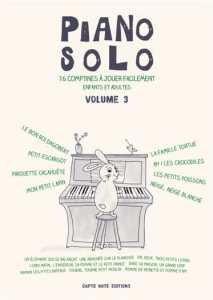
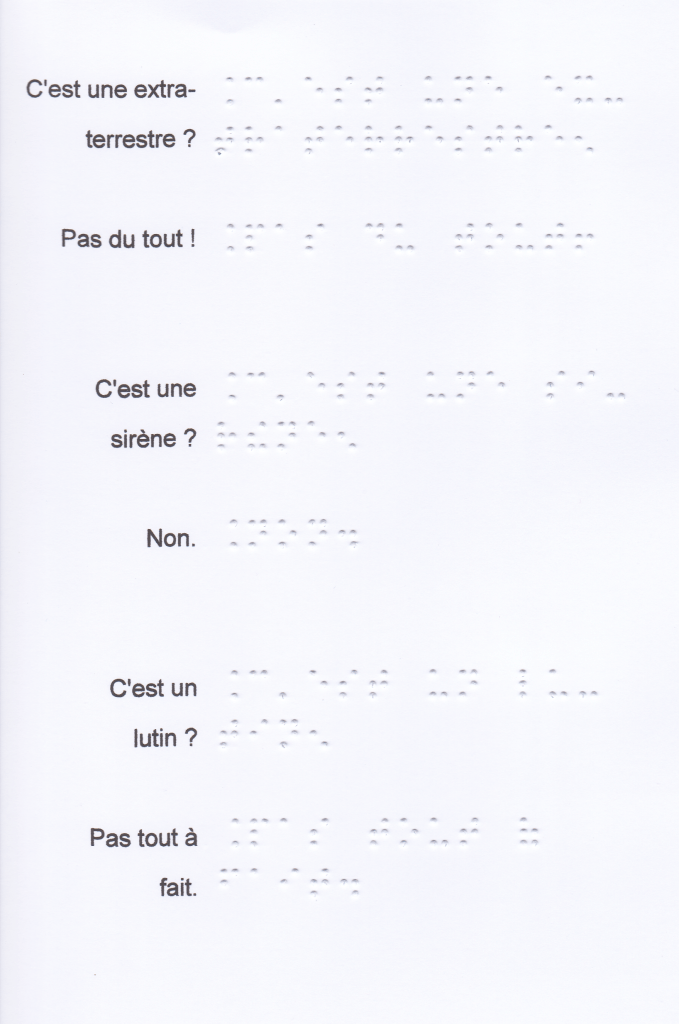
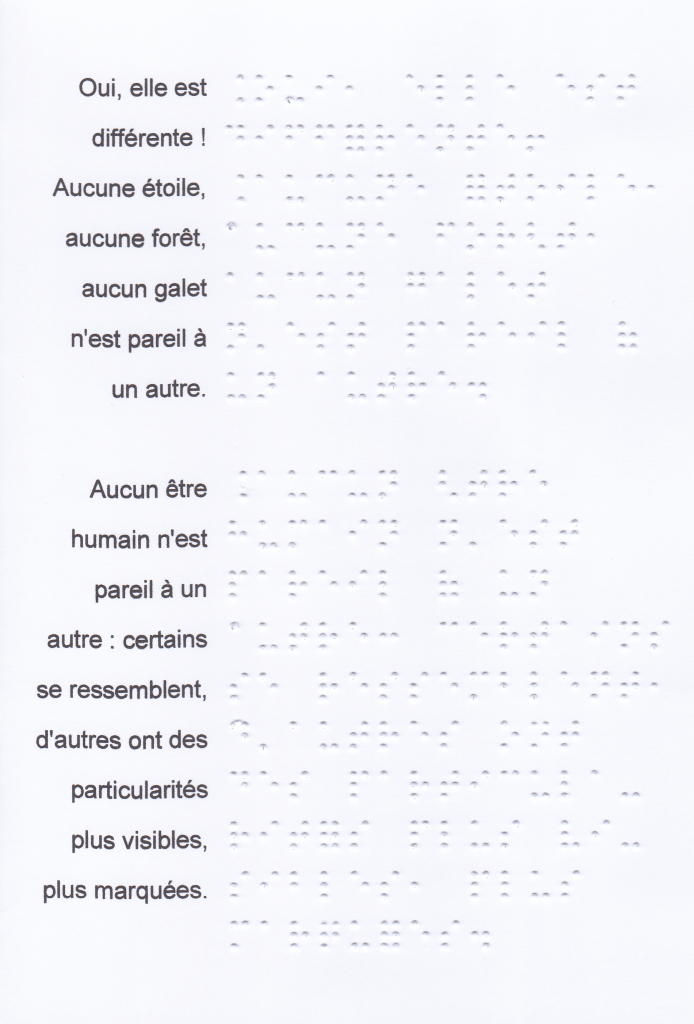
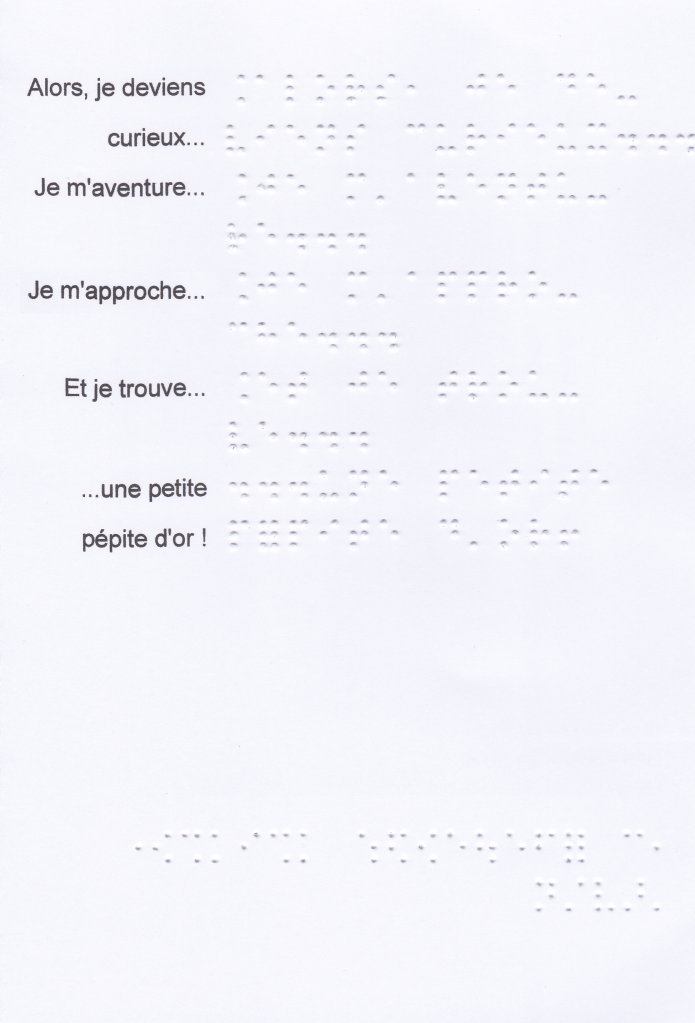
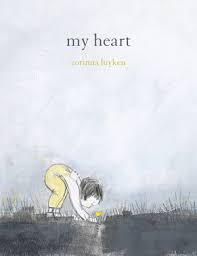
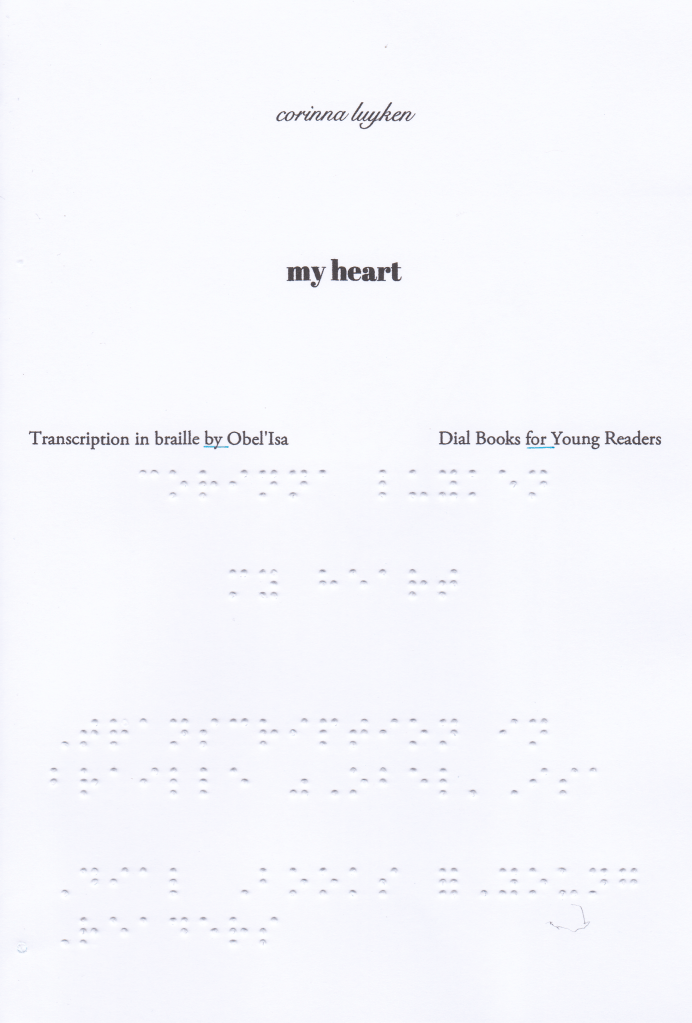
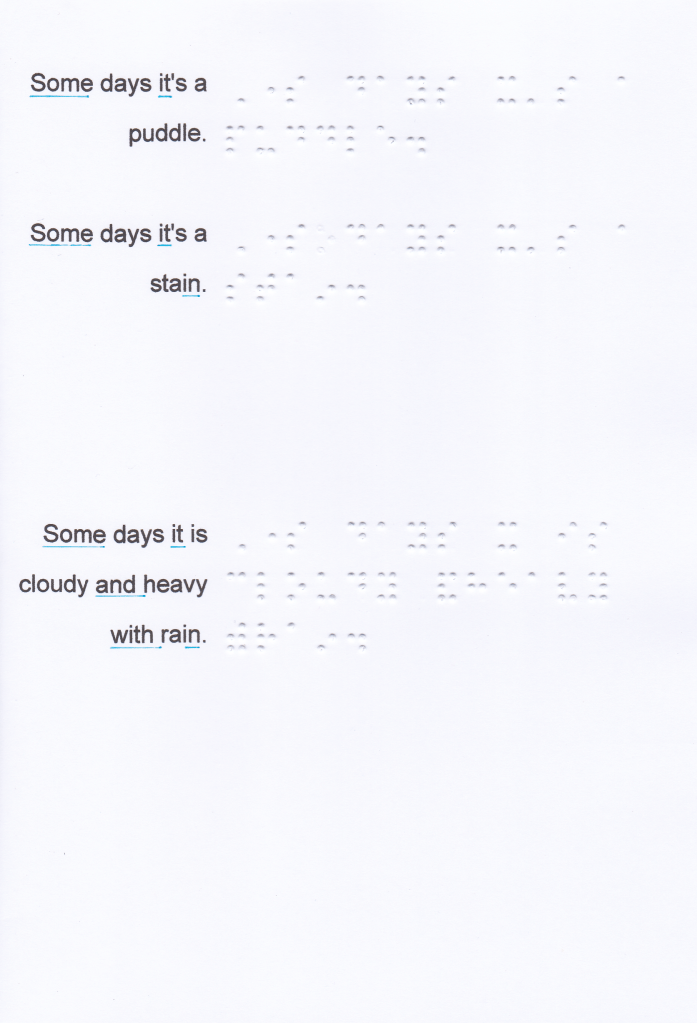
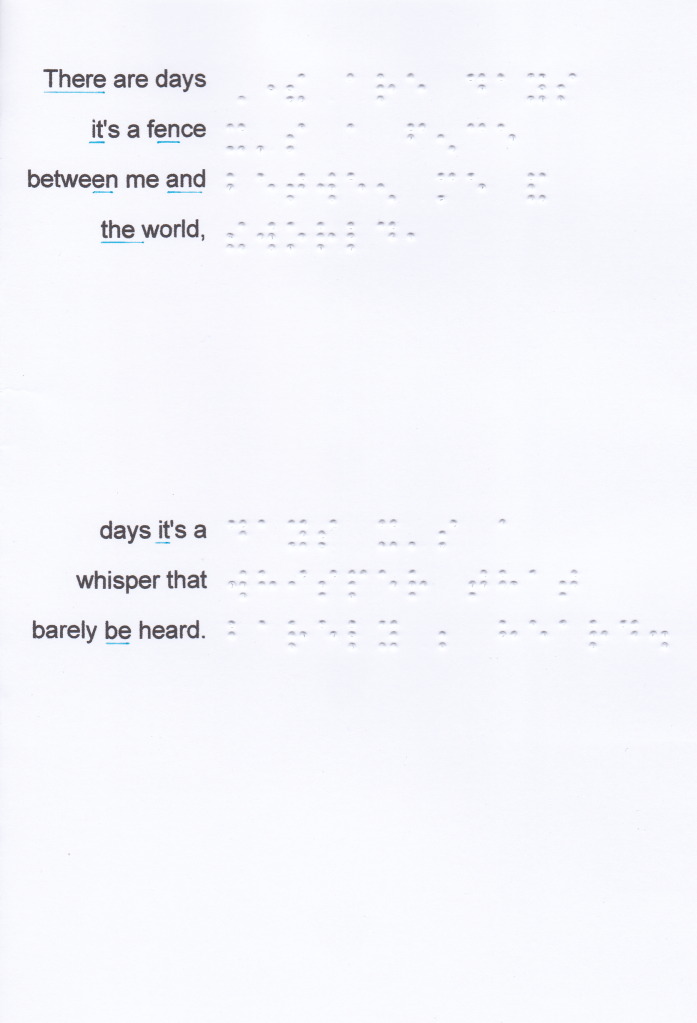
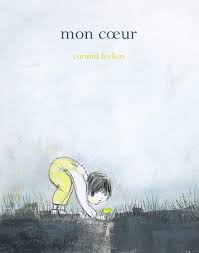
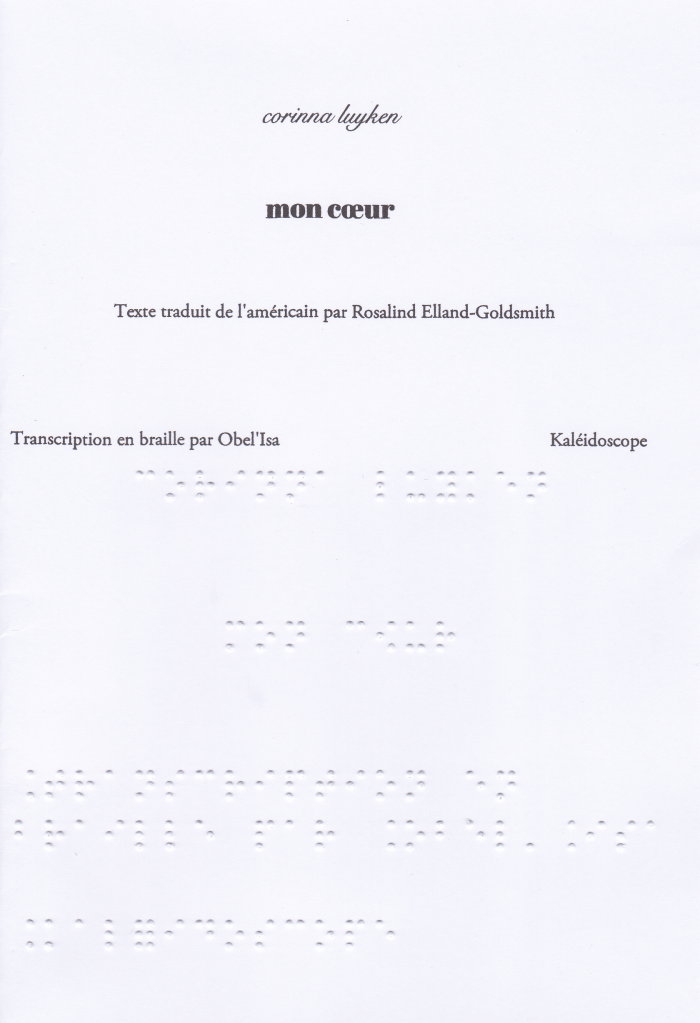
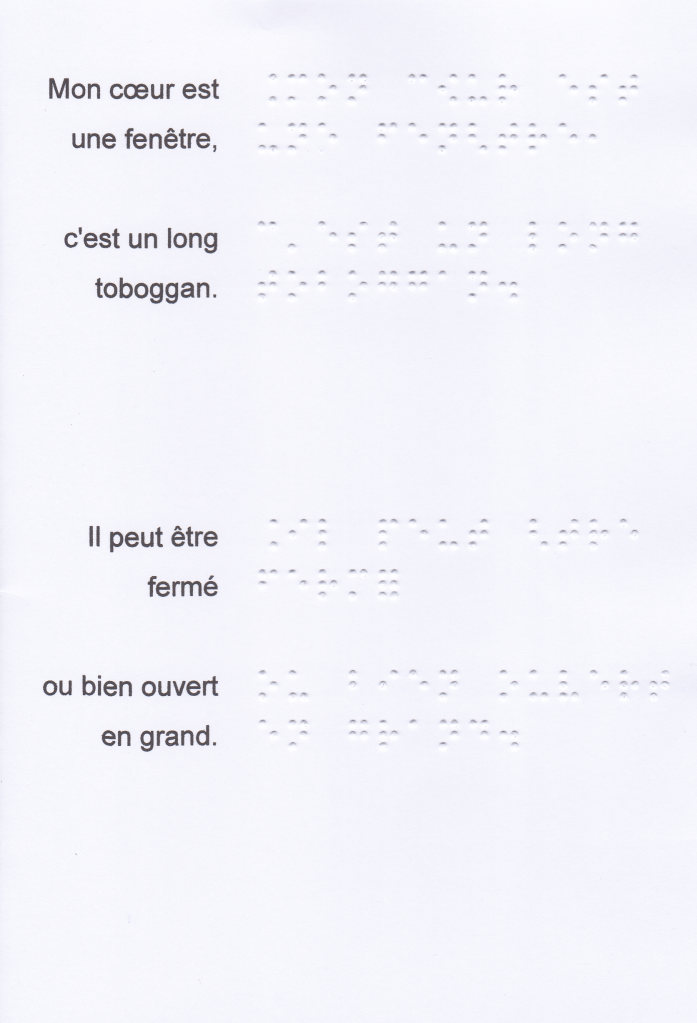
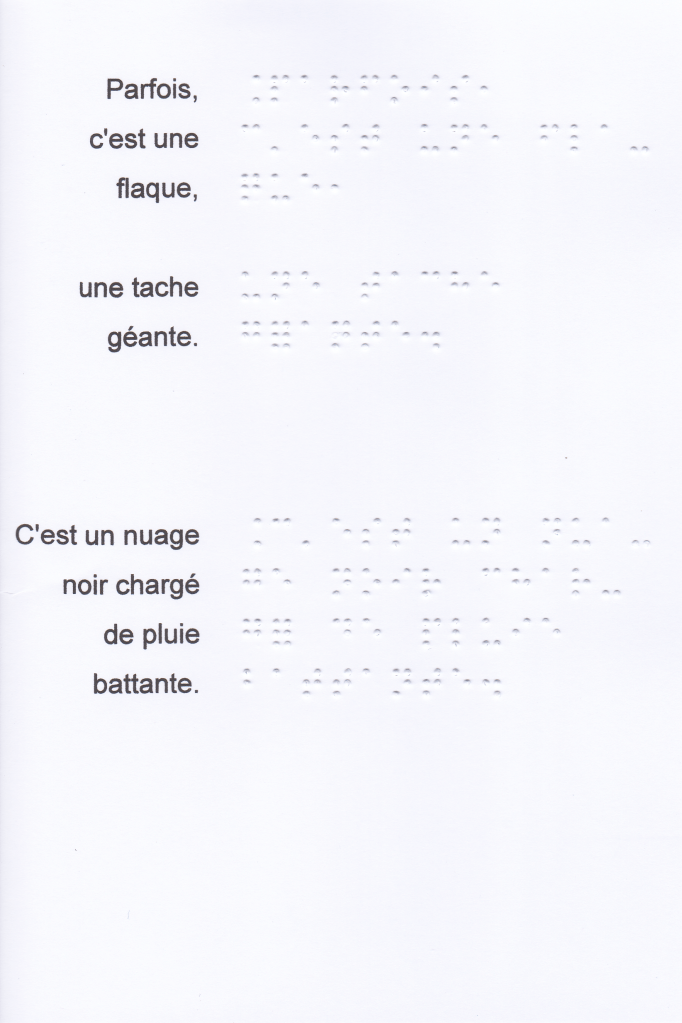
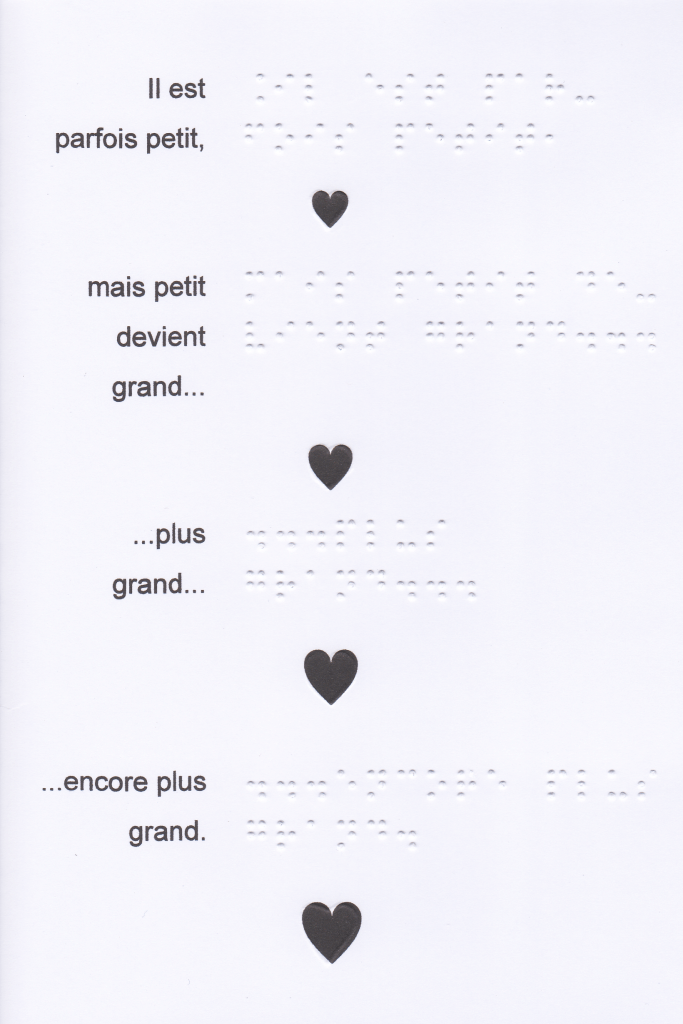
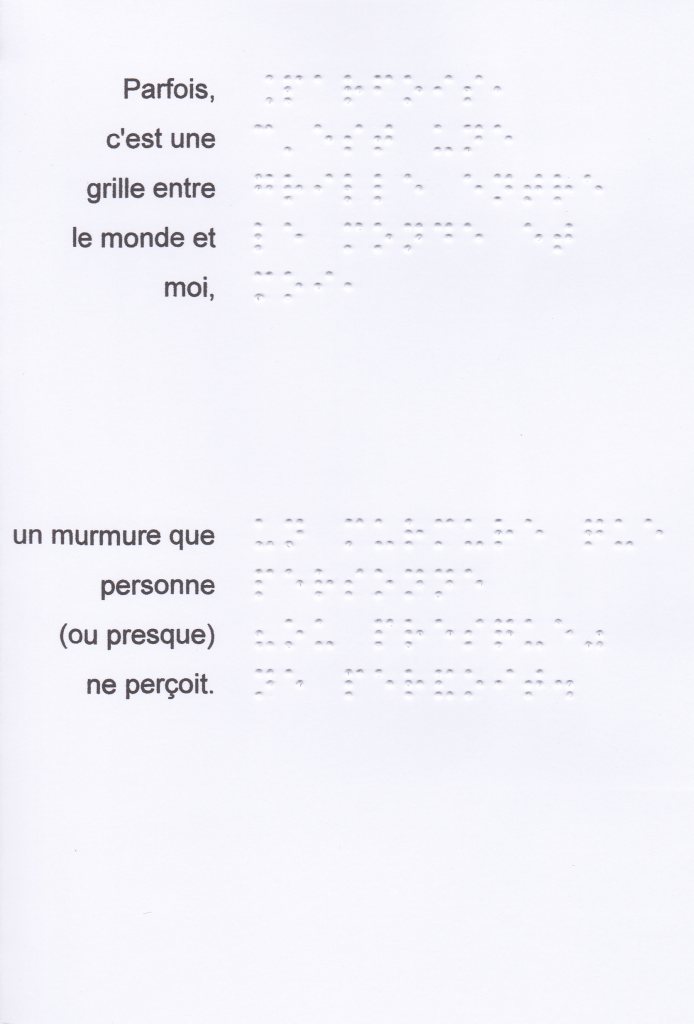
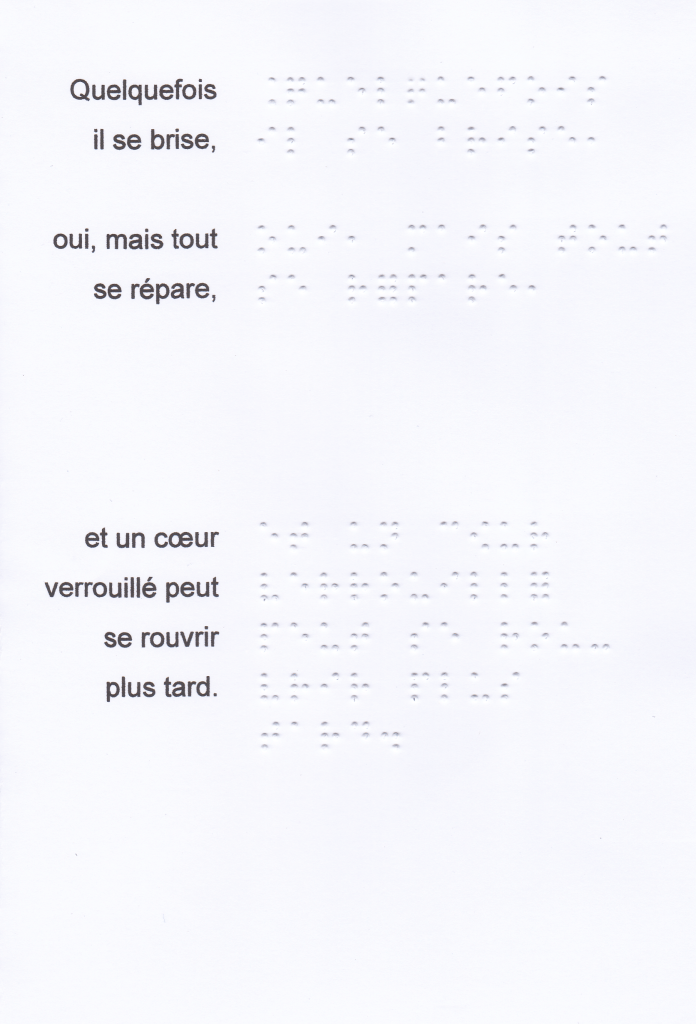
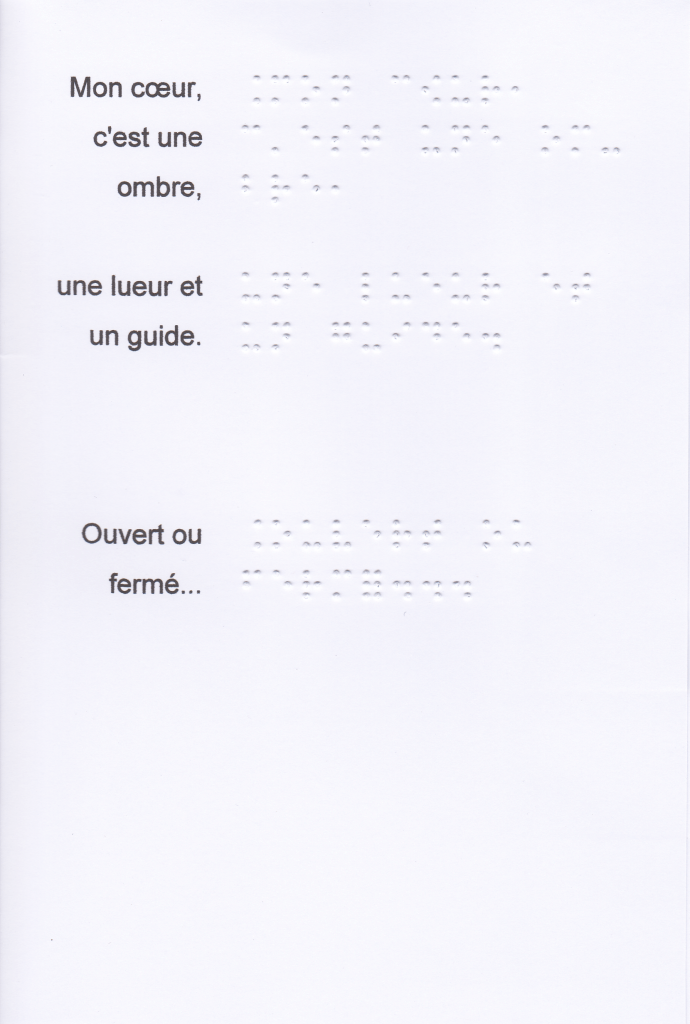
Pour la transcription, j’ai acheté l’édition de Kaléidoscope, de 2020, diffusé par l’école des loisirs. Visitez leur site Web pour plus d’informations -https://www.editions-kaleidoscope.com/.
♫♫♫
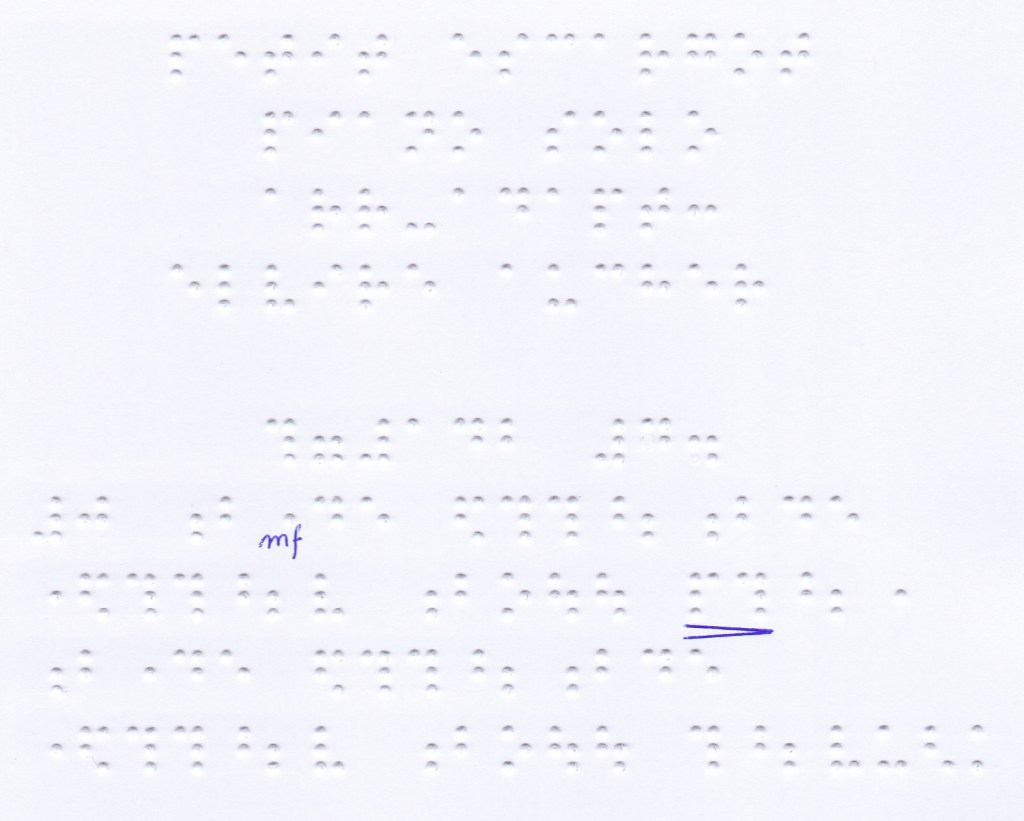
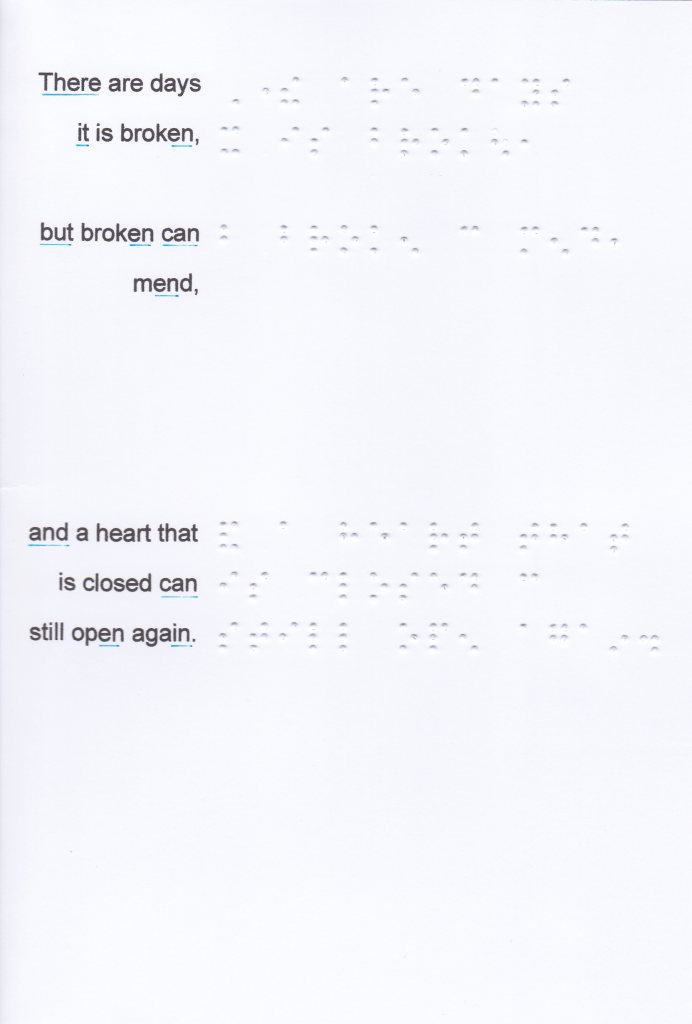
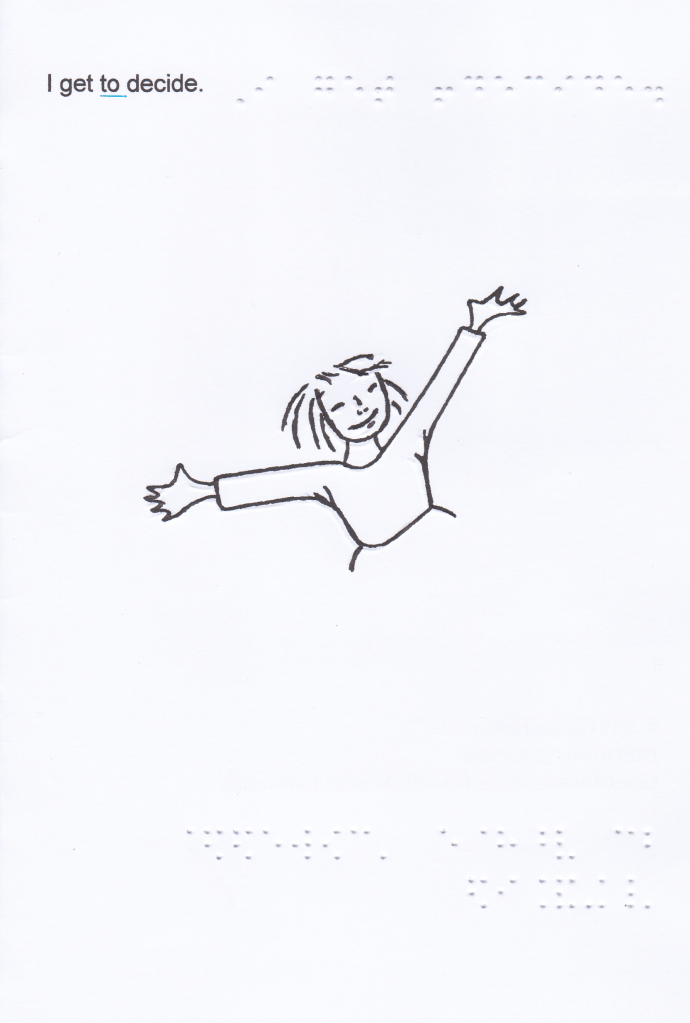
Cliquez sur la première image pour l’agrandir et faites défiler les pages comme dans le livre.
Why does contemplating the Imaginary Worlds of the Art Universe allow self-healing, if no memory, emotion, or fear blocks the process of self-regeneration?
Nothing is lost, nothing is created, everything is transformed.
To answer this question, I rely on 3 reference books:
« The Biology of Belief » by Bruce Lipton, p101
As more complex animals evolved, specialized cells took over the job of monitoring and organizing the flow of the behavior regulating signal molecules. These cells provided a distributed nerve network and central information processor, a brain. The brain’s function is to coordinate the dialogue of signal molecules within the community. Consequently, in a community of cells, each cell must acquiesce control to the informed decisions of its awareness authority, the brain. The brain controls the behavior of the body’s cells. This is a very important point to consider as we blame the cells of our organs and tissues for the health issues we experience in our lives.
EMOTIONS : FEELING THE LANGUAGE OF CELLS
In higher, more aware life forms, the brain developed a specialization that enabled the whole community to tune into the status of its regulatory signals. The evolution of the limbic system provided a unique mechanism that converted the chemical communication signals into sensations that could be experienced by all of the cells in the community. Our conscious mind experiences these signals as emotions. The conscious mind not only “reads” the flow of the cellular coordinating signals that comprise the body’s “mind” it can also generate emotions, which are manifested through the controlled release of regulatory signals by the nervous system.
At the same time that I was studying the mechanics of the cell’s brain and gaining insight into the operation of the human brain, Candace Pert was studying the human brain and becoming aware of the mechanics of the cell’s brain. In Molecules of Emotion, Pert revealed how her study of information-processing receptors on nerve cell membranes led her to discover that the same “neural” receptors were present on most, if not all, of the body’s cells. Her elegant experiments established that the “mind” was not focused in the head but was distributed via signal molecules to the whole body. As importantly, her work emphasized that emotions were not only derived through a feedback of the body’s environmental information. Through self-consciousness, the mind can use the brain to generate “molecules of emotion” and override the system. While proper use of consciousness can bring health to an ailing body, inappropriate unconscious control of emotions can easily make a healthy body diseased, a topic I will expand upon in Chapters 6 and 7. Molecules of Emotion is a very insightful book describing the scientific discovery process. It also provides some revealing insights into the struggles encountered when trying to introduce new “ideas” into science’s Old Boys Club, a subject with which I am all too familiar! (Pert 1997)
Molecules of emotion by Candace B. Pert, p141
If we accept the idea that peptides and other informational substances are the biochemicals of emotion, their distribution in the body’s nerves has all kinds of significance, which Sigmund Freund, were he alive today, would gleefully point out as the molecular confirmation of his theories. The body is the unconscious mind! Repressed traumas causes by overwhelming emotion can be stored in a body part, thereafter affecting our ability to feel that part or even move it. The new work suggests there are almost infinite pathways for the conscious mind to access -and modify- the unconscious mind and the body, and also provides an explanation for a number of phenomena that the emotional theorists have been considering.
THE MIND IN THE BODY: FILTERING, STORING, LEARNING, REMEMBERING, REPRESSING
Because of the research I’ve been describing, we can no longer consider the emotional brain to be confined to the classical locations of the amygdala, hippocampus, ans hypothalamus. For example, we have discovered other anatomical locations where high concentrations of almost every neuropeptide receptor exist, locations such as the dorsal horn, or back side of the spinal cord, which is the firt synapse within the nervous system where all somatosensory information is proceed. (The term somatosensory refers to any bodily sensations of feelings, whether it is the touch of another’s hand on our skin or sensations arising from the movement of our own organs as they carry on our bodily process.) Not just opiate receptors but almost every peptide receptor we looked for could be found in thi spinal-cord site that filters all incoming bodily sensations. In fact, we have found that in virtually all locations where information from any of the five senses -sight, sound, taste, smell and touch- enters the nervous system, we will find a high concentration of neuropeptide receptors. We have termed these regions “nodal points” (or, colloquially, “hot spots”) to emphasize that they are places where a great deal of information converges. The information is carried by axons and dendrites from many nerve bodies that are passing near or making synaptic contact with each other.
The Tao Te Ching « The Book of the Immanence of the Way » de Lao-Tseu, A New English Version by Stephen Mitchell, HarperCollins e-books
Chapter 1: The tao that can be told
The tao that can be told is not the eternal Tao. The name that can be named is not the eternal Name.
The unnamable is the eternally real. Naming is the origin of all particular things.
Free from desire, you realize the mystery. Caught in desire, you see only the manifestations.
Yet mystery and manifestations arise from the same source. This source is called darkness.
Darkness within darkness. The gateway to all understanding.
♫♫♫
Since emotions are molecules that regulate the body’s balance, they can sometimes block the body’s self-regenerating capacities.
As the mind can consciously use the brain to generate “emotion molecules” and override the system, meditation that acts on the mind will allow us to find inner peace which will neutralize the emotional molecules that blocked self-regenerating capacities.
Through meditation, the body’s self-regenerative abilities will be operational again, and they will be able to heal.
But since regulation occurs in both directions, it may be that the emotional blocks the realization of meditation.
♫♫♫
As Candace Pert points out, information from our five senses – sight, sound, taste, smell and touch – enters the nervous system, in areas with a high concentration of neuropeptide receptors.
This is why art therapy, olfactology, etc. are techniques that allow us to correct the mismatches that have occurred between the « conscious » function of the brain and the « emotional » function of the body, which until now have caused health problems.
This reinforces my idea that reading braille using the senses (touch, sight) and the brain for comprehension, can help free the receptors of emotional molecules linked to trauma, false beliefs that have been inscribed in the body’s unconscious.
Pourquoi est-ce que la contemplation des Mondes Imaginaires de l’Art Univers permet l’auto-guérison, si aucune mémoire, émotion, peur ne bloque le processus d’auto-régénération ?
Rien ne se perd, rien ne se crée, tout se transforme.
Pour répondre à cette question, je m’appuie sur 3 livres de références :
« Biologie des Croyances » de Bruce Lipton, p150
A mesure que les animaux plus complexes ont évolués, les cellules spécialisées ont pris la responsabilité de surveiller et d’organiser le flux des signaux moléculaires régulant leur comportement. Ces cellules se sont constitués en des réseaux de nerfs et un processeur central d’information, le cerveau. La fonction de ce dernier est de coordonner le dialogue des signaux moléculaires dans la communauté. En conséquence, chaque cellule d’une communauté doit obéir aux décisions éclairées de son autorité consciente, le cerveau, lequel contrôle le comportement des cellules du corps. C’est là un point dont il faut tenir compte lorsque nous accusons les cellules de notre corps des problèmes de santé qui nous affectent.
ÉMOTIONS : COMPRENDRE LE LANGAGE DES CELLULES
Chez les formes de vie supérieures plus conscientes, le cerveau s’est spécialisé pour permettre à toute la communauté de se syntoniser sur ses signaux régulateurs. Le système limbique s’est doté d’un mécanisme unique qui convertit les signaux communicationnels chimiques en sensations que toutes les cellules de la communauté sont aptes à ressentir. Notre conscient ne se limite pas à « lire » le flux de signaux de coordination cellulaire qui constituent la « conscience » corporelle. En réalité, il peut également générer des émotions sous la forme d’une émission de signaux régulateurs contrôlée par le système nerveux.
Au moment où j’étudiais les mécanismes du cerveau cellulaire et que je comprenais de plus en plus le fonctionnement du cerveau humain, Candace Pert étudiait le cerveau humain et comprenait de mieux en mieux les mécanismes du cerveau cellulaire. Dans Molecules of Emotion [Molécules d’émotions], Pert révèle comment, en étudiant les récepteurs d’information situés sur les membranes des cellules nerveuses, elle a découvert que ces récepteurs nerveux étaient présents dans la plupart, sinon la totalité, des cellules du corps. Par ces expériences, elle a établi que l’« esprit » n’est pas uniquement localisé dans la tête, mais réparti dans tout le corps, sous forme de signaux moléculaires. Son travail soulignait en outre que les émotions n’émanent pas seulement d’une réaction à l’information provenant de l’environnement physique. Le mental peut consciemment utiliser le cerveau pour générer des « molécules d’émotion » et outrepasser le système. Si la conscience, employée judicieusement, peut améliorer la santé du corps, le contrôle inconscient des émotions peut aisément nuire à la santé du corps, sujet approfondi dans les chapitres 6 et 7. Molecules of Emotion est un livre très inspirant qui décrit le processus de découvertes scientifiques. Il présente un aperçu des luttes auxquelles sont confrontés ceux qui tentent de soumettre le nouvelles « idées » à l’ordre scientifique établi, un sujet qui m’est très familier !
Molecules of emotion de Candace B. Pert, p141 Traduit en français par moi-même car le livre en français « Molécules d’émotion » n’existe pas.
Si l’on accepte l’idée que les peptides et autres substances informationnelles sont les substances biochimiques de l’émotion, leur distribution dans les nerfs du corps revêt une importance considérable, que Sigmund Freund, s’il était encore en vie, soulignerait avec joie comme la confirmation moléculaire de ses théories. Le corps est l’inconscient ! Les traumatismes refoulés causés par une émotion intense peuvent être stockés dans une partie du corps, affectant ainsi notre capacité à ressentir cette partie, voire à la bouger. Ces nouveaux travaux suggèrent qu’il existe une infinité de voies permettant à l’esprit conscient d’accéder à l’inconscient et au corps – et de les modifier – et fournissent également une explication à un certain nombre de phénomènes étudiés par les théoriciens de l’émotion.
L’ESPRIT DANS LE CORPS : FILTRER, STOCKER, APPRENDRE, SE SOUVENIR, RÉPRIMER
Grâce aux recherches que je viens de décrire, nous ne pouvons plus considérer le cerveau émotionnel comme confiné aux localisations classiques de l’amygdale, de l’hippocampe et de l’hypothalamus. Par exemple, nous avons découvert d’autres localisations anatomiques où se trouvent de fortes concentrations de presque tous les récepteurs de neuropeptides, comme la corne dorsale ou la face postérieure de la moelle épinière, première synapse du système nerveux où transite toute information somatosensorielle. (Le terme somatosensoriel désigne toute sensation corporelle, qu’il s’agisse du contact de la main d’autrui sur notre peau ou des sensations résultant du mouvement de nos propres organes dans le cadre de nos fonctions corporelles.) Non seulement les récepteurs aux opiacés, mais presque tous les récepteurs peptidiques que nous recherchions se trouvaient dans ce site de la moelle épinière qui filtre toutes les sensations corporelles. En fait, nous avons constaté que pratiquement partout où l’information provenant des cinq sens – vue, ouïe, goût, odorat et toucher – pénètre dans le système nerveux, se trouve une forte concentration de récepteurs de neuropeptides. Nous avons appelé ces régions « points nodaux » (ou, familièrement, « points chauds ») pour souligner qu’il s’agit de lieux où converge une grande quantité d’informations. L’information est véhiculée par les axones et les dendrites de nombreux corps nerveux qui se croisent ou établissent un contact synaptique.
Le Tao Te King « Le livre de la Voie et de la Vertu » de Lao-Tseu Traduit du chinois par Stanislas Julien, éditions mille et une nuits
Chapitre 1
La voie qui peut être exprimée par la parole n’est pas la Voie éternelle ; le nom qui peut être nommé n’est pas le Nom éternel.
(L’être) sans nom est l’origine du ciel et de la terre ; avec un nom, il est la mère de toutes choses.
C’est pourquoi, lorsqu’on est constamment exempt de passion, on voit son essence spirituelle, lorsqu’on a constamment des passions, on le voit sous une forme bornée.
Ces deux choses ont une même origine et reçoivent des noms différents. On les appelle toutes deux profondes. Elles sont profondes, doublement profondes. C’est la porte de toutes les choses spirituelles.
♫♫♫
Les émotions étant des molécules de régulation de l’équilibre du corps, il peut arriver qu’elles bloquent les capacités auto-régénérantes du corps.
Comme le mental peut consciemment utiliser le cerveau pour générer des « molécules d’émotion » et outrepasser le système, la méditation qui agit sur le mental, va nous permettre de retrouver la paix intérieure qui va neutraliser les molécules émotionnelles qui bloquaient les capacités auto-régénérantes.
Grâce à la méditation, les capacités d’auto-régénération du corps seront à nouveau opérationnelles, et vont pouvoir le guérir.
Mais comme la régulation se réalise dans les deux sens, il se peut que l’émotionnel bloque la réalisation de la méditation.
♫♫♫
Comme le souligne Candace Pert, l’information provenant de nos 5 sens – vue, ouïe, goût, odorat et toucher – pénètre dans le système nerveux, dans des zones à forte concentration de récepteurs de neuropeptides.
C’est pourquoi, l’art thérapie, l’olfactologie,… sont des techniques qui permettent de corriger les mauvais appariements survenus entre la fonction « consciente » du cerveau et la fonction « émotionnelle » du corps, qui jusque là provoquent des problèmes de santé.
Cela renforce mon idée que la lecture braille utilisant les sens (toucher, vue) et le cerveau pour la compréhension, peut aider à libérer les récepteurs des molécules émotionnelles liées à des traumatismes, des fausses croyances qui se sont inscrites dans l’inconscient du corps.
Every time I see the notion of the expansion of the Universe appear, my cells react and awaken in me a feeling that it is false, « No, the Universe is not expanding. »
Nothing is lost, nothing is created, everything is transformed.
Here are 3 book excerpts to shed light on my thoughts:
« The Biology of Belief » by Bruce Lipton, p103
Humans and a number of other higher mammals have evolved a specialized region of the brain associated with thinking, planning, and decision-making called the prefrontal cortex. This portion of the forebrain is apparently the seat of the “self-conscious” mind processing. The self-conscious mind is self-reflective; it is a newly evolved “sense organ” that observes our own behaviors and emotions. The self-conscious mind also has access to most of the data stored in our long-term memory bank. This is an extremely important feature allowing our history of life to be considered as we consciously plan our futures.
Endowed with the ability to be self-reflective, the self-conscious mind is extremely powerful. It can observe any programmed behavior we are engaged in, evaluate the behavior, and consciously decide to change the program. We can actively choose how to respond to most environmental signals and whether we even want to respond at all. The conscious mind’s capacity to override the subconscious mind’s preprogrammed behaviors is the foundation of free will.
However, our special gift comes with a special pitfall. While almost all organisms have to actually experience the stimuli of life first-hand, the human brain’s ability to “learn” perceptions is so advanced that we can actually acquire perceptions indirectly from teachers. Once we accept the perceptions of others as “truths,” their perceptions become hardwired into our own brains, becoming our “truths.” Here’s where the problem arises: what if our teachers’ perceptions are inaccurate? In such cases, our brains are then downloaded with misperceptions. The subconscious mind is strictly a stimulus-response playback device; there is no “ghost” in that part of the “machine” to ponder the long-term consequences of the programs we engage. The subconscious works only in the “now.” Consequently, programmed misperceptions in our subconscious mind are not “monitored” and will habitually engage us in inappropriate and limiting behaviors.
Molecules of emotion by Candace B. Pert, p135
DO EMOTIONS ORIGINATE IN THE HEAD OR THE BODY
Until 1984 I had assumed that Wilder Penfield’s famous human experiments had proved beyond a shadow of a doubt that emotions originate in the brain. But that year, I went to give a lecture et the Second International Meeting of the Society for the Study of Emotion, which was held at Havard, and there I met Eugene Taylor, the scientific historian in the psychology department. He was excited about the lecture I had just delivered, in which I presented the theory of peptides and other ligands as the biochemicals of emotion. Eugene wanted to know where I stood on the famous James-Cannon debate, which, he reminded me, was about the ultimate sources of emotions. Do they originate in the body and then get perceived in the head, where we invent a story to explain them, as William James said? Or do they originate in the head and trickle down to the body, as Walter Cannon posited?
In 1884, while an assistant professor of philosophy at Havard, William James had published his essay “What Is an Emotion?” basing his theory on his own introspective observation and a general knowledge of physiology. He said he had concluded that the source of emotion is purely visceral, that is, originating in the body and not cognitive, originating in the mind, and that there is probably no brain center for emotional expression. We perceive events and have bodily feelings, and then after the perception, which joggles our memories and imagination, we label our physical sensations as one or another emotion. However, he believed that there was in fact no such entity as emotion. There is simply perception and bodily response. The immediate sensory and motor reverberations that occur in response to the perception -the pounding heart, the tight stomach, the tensed muscles, the sweaty palms- are the emotions. And the emotions are felt throughout the body as sensations, “each morsel of which contributes its pulsation of feeling, dim or sharp, pleasant or painful or dubious, to that sense of personality that every one of us unfailingly carries with him.” Emotions consist of organic changes in the body, muscular and visceral, and are not a primary feeling directly aroused, but a secondary one, indirectly aroused by the body’s workings.
Like many appealing armchair theories, James’s seemed to collapse under the weight of real data, in this case, animal laboratory word performed by his student Walter Cannon, the experimental physiologist and author of Wisdom of the body, who, by 1927 had explained the workings of the sympathetic autonomic nervous system. A single nerve called the vagus (“wandering”) nerve exits the back of the brain through a hole in the bottom of the skull (the foramen magnum) then splits to rum down the bundles of nerves cells, or ganglia, along either side of the spinal cord to send branches to many organs, including thz pupils of the eye, the salivary glands, the heart, the bronchi of the lungs, the stomach, the intestines, the bladder, the sex organs, and the adrenal glands (from which the hormone adrenaline is released). When Cannon stimulated the vagus through electrodes implants in the hypothalamus in the bottom of the brain just above the pituitary gland, he demonstrated physiological changes in all these organs consistent with what would be needed by the body in an emergency situation when resources had to be quickly, efficiently, and automatically managed without any time-wasting through. As the result of this hypothalamic stimulation, for example, blood from the internal organs of digestion was quickly rerouted to the muscles for “fight or flight” -digestion could wait until the emergency was over- and an increased output of adrenaline stimulated the heart and caused the liver to release extra supplies of sugar for instant energy.
From Cannon’s point of view, Jame’s theory of visceral emotion was all wet. Cannon could accurately measure how much time it took from the moment the hypothalamus got an electrical jolt to the moment the bodily changes in blood flow, digestion, and heartbeat began to occur as a result. And his conclusion was that these changes were just too slow to be the cause of emotions rather than the effect. Also, artificial induction of visceral changes that were typical of strong emotions, such as the use of electrical current to produce a strong intestinal contraction like that which occurs in the first moment of panic, failed to produce the other signs of that emotion. Not only that, Cannon pointed out that animals whose vagal nerve had been cut, and presumably were incapable of sympathetic visceral bodily changes, still seemed to behave just as emotionally when placed in a threatening situation. According to Cannon, the hypothalamus of the brain was the seat of the emotions, which trickled down to the body through the hypothalamus’s neuronal connections to the back of the brain, or brainstem, or through the secretions of the pituitary gland.
While Eugene Taylor waited expectantly for my late-twentieth-century spin on the somewhat arcane James-Cannon debate, I suddenly had a big aha!: “Why, it’s both! It’s not either/or; in fact, it’s both and neither! It’s simultaneous -a two-way street,” I blurted out. I had just realized that the resolution of a debate whose origins went back over a century held the key t understanding a very modern conundrum: How can emotions transform the body, either creating disease or healing it, maintaining health or undermining it?
The Tao Te Ching « The Book of the Immanence of the Way » de Lao-Tseu, A New English Version by Stephen Mitchell, HarperCollins e-books
Chapter 42: The Tao gives birth to One…
The Book of the Immanence of the Way
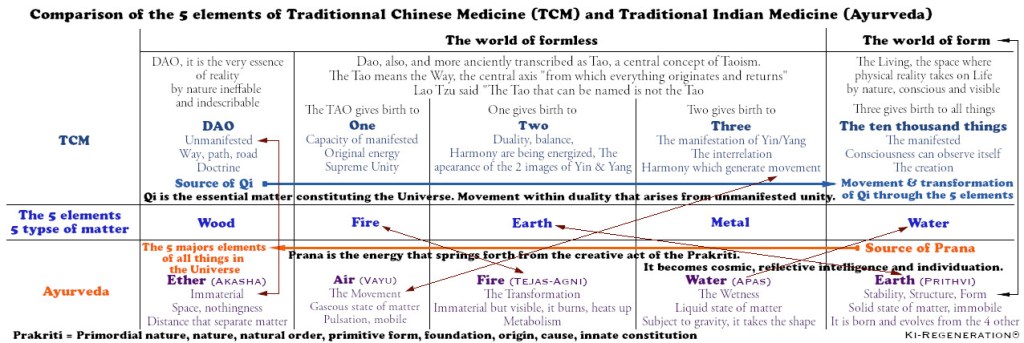
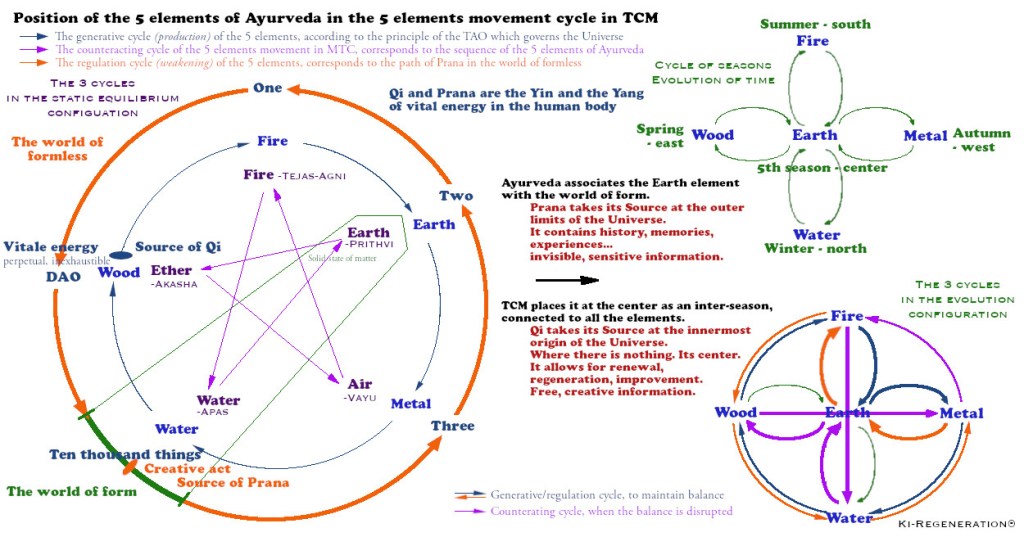
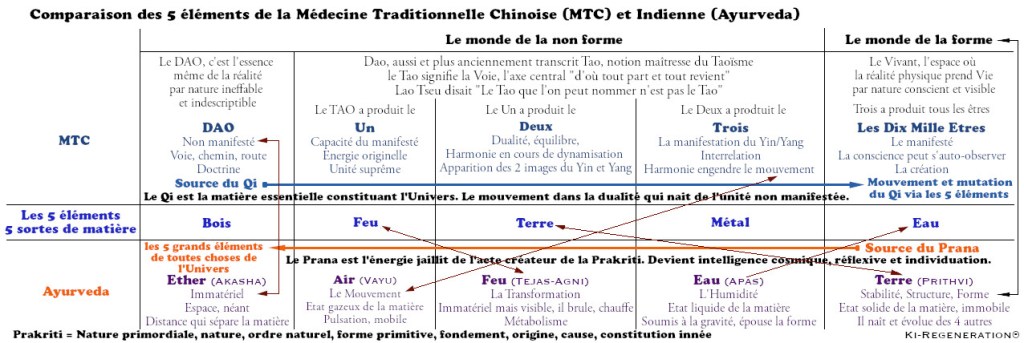
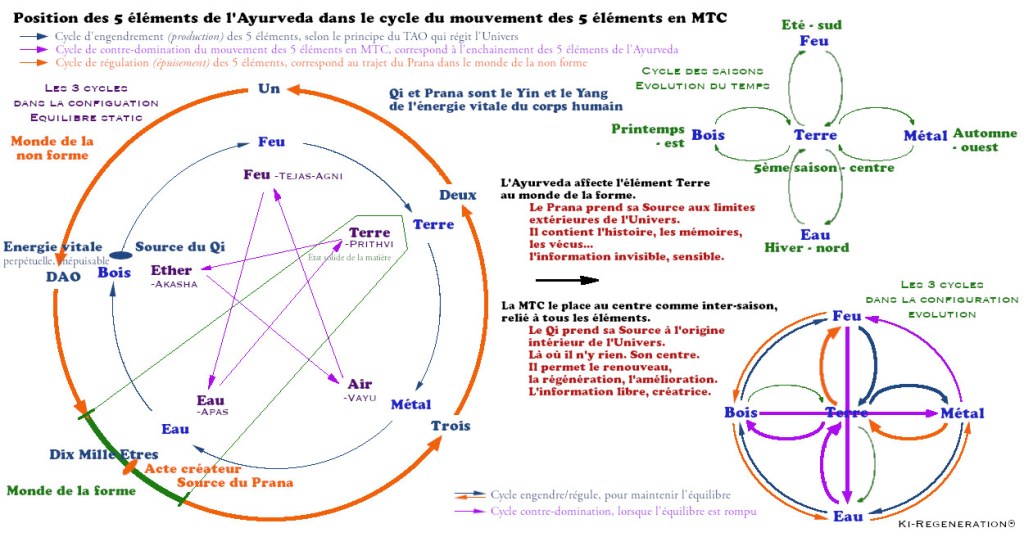
Philosophy taken up in traditional Chinese medicine
DAO, this text is not part of chapter 42. The DAO is the very essence of reality and by nature ineffable and indescribable, the unnameable eternal Way.
The unmanifested World of formless
The Tao gives birth to One.
= Capacity of the manifested. Original energy. Supreme unity.
One gives birth to Two.
= Duality, balance, and harmony are being energized The appearance of the two images of Yin and Yang.
Two gives birth to Three.
= The manifestation of Yin/Yang, the interrelation, harmony which generates movement.
Three gives birth to all things.
The manifested World of form, consciousness can observe itself, creation.
All things have their backs to the female and stand facing the male. When male and female combine, all things achieve harmony.
I think that emotions, our bodily sensations, make us interact with each other, allow us to sit calmly in meditation or make us agitate in all directions. Resist or let go. Making an unmanifested space visible, creating from a manifested fixed point, an impression of expansion.
Ordinary men hate solitude. But the Master makes use of it, embracing his aloneness, realizing he is one with the whole universe.
Ki’Chi’Qi
♫♫♫
Today, we have specialized everything to understand the details of things, but have we not lost sight of the overall plan of Life?
We all agree that We, human beings, are Alive and Conscious.
And if the Universe was Alive and Conscious too!
Isn’t it time to bring together Quantum Physics, Biology, Philosophy… in order to find the place of each thing in the great Universal whole of Life?
Isn’t it time to consider the Cosmos as a Living and Conscious Universe?
♫♫♫
We are the Cosmic Universe entangled in the Universe.
We are born as children, then adolescents, then adults. Our bodies grow. We are born, live, and die. Our earthly life is limited within a given space-time.
The Universe was born; it is the space that allowed atoms, planets… and us to appear. Its space is limited in time.
There is no expansion possible outside of the DAO.
If we put ourselves in the shoes of our ancestors who did not know that the Earth was round and vast, the more they advanced, the more they discovered, but the Earth was not expanding.
Water spreading across the ground obeys the laws of gravity; it moves and takes up more space, but it is not expanding. There is no more water on the ground than in the bowl that contained it.
I think it’s the same for the Universe. The more we increase our consciousness, and the precision of our calculations, the further we see, but the Universe is not expanding. I would say it’s like the Earth, water in a bowl, which have a finite space-volume in motion; the Universe also has a finite space in motion, the DAO. This is the best word I can find to describe it. The DAO is not accessible to our human perception, to our manifested consciousness, perhaps that’s why the brain « chooses » the word expansion which sounds false to me.
Unlike our ancestors, our brains have developed enormously since the Age of Enlightenment, allowing us to develop models and theories before experimentation. Whereas they experimented with things and then deduced models.
For me, the universe is not expanding; models show us that there is something beyond what our consciousness can conceive.
Bruce Lipton, in his book « The Biology of Belief », tells us that we have developed such a powerful brain that by analyzing situations, it can deduce truths that may be « false », but to which it clings and which blocks opportunities because « programmed misperceptions in our subconscious mind are not “monitored” ».
Candace Pert shows that our emotions are a bridge between our body and our brain, our mind. They could allow us to overcome false signals and stay on course for a harmonious life.
♫♫♫
Life is not an unlimited expansion for material experiences/creations; rather, it is a perpetual movement to achieve ultimate harmony. I don’t think that developing our brains or AI will solve the existential problems facing humanity.
It would be wise to stop for a moment, to make an interconnection of all our specializations, our emotions, to find the plan of Life on Earth and choose the right Way.
A chaque fois que je vois apparaître la notion d’expansion de l’Univers, mes cellules réagissent et éveillent en moi une sensation que c’est faux, « Non l’Univers n’est pas en expansion ».
Rien ne se perd, rien ne se crée, tout se transforme.
Voici 3 extraits de livres pour éclairer ma réflexion :
« Biologie des Croyances » de Bruce Lipton, p153
Chez les humains, comme chez certains mammifères supérieurs, une région du cerveau s’est spécialisée ; elle est associée à la pensée, à la planification et à la prise de décision. C’est le cortex préfrontal. Cette partie du cerveau antérieur semblerait être le siège de l’activité mentale « consciente ». Le conscient est capable d’autoréflexion. Cet organe de perception, dont l’évolution est récente, observe nos propres comportements et émotions. De plus, il a accès à presque toute l’information stockée dans notre mémoire à long terme. Cette aptitude est extrêmement importante, car elle nous permet de considérer l’historique de notre vécu au moment de planifier consciemment l’avenir.
Grâce à sa capacité d’autoréflexion, le conscient est extrêmement puissant. Il est capable d’observer tous nos comportements programmés, de les évaluer et de décider consciemment d’en changer le programme. Nous pouvons choisir consciemment notre manière de réagir à la plupart des signaux de l’environnement, ou d’y répondre ou pas. La capacité consciente d’outrepasser les automatismes du subconscient constitue le fondement du libre arbitre.
Ce don particulier comporte néanmoins un désavantage tout aussi particulier. Alors que la plupart des organismes doivent faire eux-mêmes l’expérience de stimuli, notre cerveau est si apte à « apprendre » les perceptions, que nous pouvons les acquérir indirectement de nos éducateurs. Une fois que nous acceptons celles des autres comme des « vérités », leurs perceptions se cristallisent dans notre cerveau et deviennent nos « vérités ». Or, cela peut poser un problème. Qu’arrive-t-il si les perceptions de nos éducateurs sont inexactes ? Dans ce cas, de fausses perceptions sont téléchargées dans notre cerveau. Comme l’inconscient sert uniquement à rejouer le mode stimuli-réactions, il n’y a pas de « fantôme » dans cette partie de la « machine » pour évaluer les conséquences à long terme de cette programmation. L’inconscient travaille uniquement au « présent ». Par conséquent, les fausses perceptions programmées dans notre inconscient ne sont pas « surveillées » et nous entrainent dans des comportements inappropriés et restreints.
Molecules of emotion de Candace B. Pert, p135 in english book. Traduit en français par moi-même car le livre en français « Molécules d’émotion » n’existe pas.
LES ÉMOTIONS PROVIENNENT-ELLES DE LA TÊTE OU DU CORPS ?
Jusqu’en 1984, j’avais supposé que les célèbres expériences humaines de Wilder Penfield avaient prouvé sans l’ombre d’un doute que les émotions provenaient du cerveau. Mais cette année-là, j’ai donné une conférence lors de la deuxième réunion internationale de la Société pour l’étude de l’émotion, qui se tenait à Harvard, et j’y ai rencontré Eugene Taylor, historien des sciences au département de psychologie. Il était enthousiasmé par la conférence que je venais de donner, où je présentais la théorie des peptides et autres ligands comme substances biochimiques de l’émotion. Eugène voulait savoir où j’en étais dans le célèbre débat James-Cannon, qui, me rappela-t-il, portait sur les sources ultimes des émotions. Proviennent-elles du corps puis sont perçues dans la tête, où nous inventons une histoire pour les expliquer, comme le disait William James ? Ou naissent-elles de la tête et se propagent-elles au corps, comme le postulait Walter Cannon ?
En 1884, alors professeur adjoint de philosophie à Harvard, William James publia son essai « Qu’est-ce qu’une émotion ?», fondant sa théorie sur sa propre observation introspective et ses connaissances générales en physiologie. Il concluait que la source de l’émotion est purement viscérale, c’est-à-dire, provenant du corps, et non cognitive, provenant de l’esprit, et qu’il n’existe probablement pas de centre cérébral d’expression émotionnelle. Nous percevons des événements et éprouvons des sensations physiques, puis, après cette perception, qui stimule nos souvenirs et notre imagination, nous qualifions nos sensations physiques d’émotions. Cependant, il pensait qu’en réalité, l’émotion n’existait pas. Il n’y avait qu’une perception et une réponse corporelle. Les réverbérations sensorielles et motrices immédiates qui se produisent en réponse à la perception – le cœur qui bat, l’estomac serré, les muscles tendus, les mains moites – sont les émotions. Et les émotions sont ressenties dans tout le corps comme des sensations, « dont chaque morceau apporte sa pulsation de sentiment, faible ou aiguë, agréable ou douloureuse ou douteuse, à ce sentiment de personnalité que chacun de nous porte infailliblement avec lui. » Les émotions consistent en des changements organiques dans le corps, musculaires et viscéraux, et ne sont pas un sentiment primaire directement suscité, mais un sentiment secondaire, indirectement suscité par le fonctionnement du corps.
Comme beaucoup de théories de salon séduisantes, celle de James semblait s’effondrer sous le poids des données réelles, en l’occurrence, des expériences de laboratoire réalisées par son élève Walter Cannon, physiologiste expérimental et auteur de La Sagesse du corps, qui, en 1927, avait expliqué le fonctionnement du système nerveux autonome sympathique. Un nerf unique, le nerf vague (« nerf errant »), sort de l’arrière du cerveau par un orifice situé à la base du crâne (le foramen magnum), puis se divise pour parcourir les faisceaux de cellules nerveuses, ou ganglions, de chaque côté de la moelle épinière et envoyer des ramifications vers de nombreux organes, notamment les pupilles, les glandes salivaires, le cœur, les bronches, l’estomac, les intestins, la vessie, les organes sexuels et les glandes surrénales (d’où est libérée l’hormone adrénaline). Lorsque Cannon a stimulé le nerf vague au moyen d’électrodes implantées dans l’hypothalamus, situé à la base du cerveau, juste au-dessus de l’hypophyse, il a observé des changements physiologiques dans tous ces organes, compatibles avec les besoins de l’organisme en situation d’urgence, où les ressources devaient être gérées rapidement, efficacement et automatiquement, sans perte de temps. Grâce à cette stimulation hypothalamique, par exemple, le sang des organes internes de la digestion a été rapidement redirigé vers les muscles pour une réaction de « combat ou de fuite » ; la digestion pouvait attendre la fin de l’urgence. Une augmentation de la production d’adrénaline a stimulé le cœur et incité le foie à libérer des réserves supplémentaires de sucre pour une énergie instantanée.
Du point de vue de Cannon, la théorie de l’émotion viscérale de James était totalement fausse. Cannon pouvait mesurer avec précision le temps écoulé entre le moment où l’hypothalamus recevait une décharge électrique et celui où les modifications corporelles de la circulation sanguine, de la digestion et du rythme cardiaque commençaient à se produire. Il concluait que ces changements étaient tout simplement trop lents pour être la cause des émotions plutôt que leur effet. De plus, l’induction artificielle de modifications viscérales typiques des émotions fortes, comme l’utilisation d’un courant électrique pour produire une forte contraction intestinale semblable à celle qui se produit au premier moment de panique, ne produisait pas les autres signes de cette émotion. De plus, Cannon soulignait que les animaux dont le nerf vague avait été sectionné, et vraisemblablement incapables de modifications corporelles viscérales sympathiques, semblaient néanmoins se comporter de manière tout aussi émotionnelle face à une situation menaçante. Selon Cannon, l’hypothalamus du cerveau était le siège des émotions, qui se propageaient jusqu’au corps par l’intermédiaire des connexions neuronales de l’hypothalamus à l’arrière du cerveau, ou tronc cérébral, ou par l’intermédiaire des sécrétions de l’hypophyse.
Tandis qu’Eugene Taylor attendait avec impatience mon point de vue de la fin du XXe siècle sur le débat quelque peu obscur James-Cannon, j’ai soudain eu une grande révélation : « Eh bien, c’est les deux ! Ce n’est pas l’un ou l’autre ; en fait, c’est les deux et aucun ! C’est simultané – une voie à double sens », ai-je lâché. Je venais de réaliser que la résolution d’un débat dont les origines remontaient à plus d’un siècle détenait la clé pour comprendre une énigme très moderne : comment les émotions peuvent-elles transformer le corps, soit créer la maladie, soit la guérir, soit maintenir la santé, soit la miner ?
Le Tao Te King « Le livre de la Voie et de la Vertu » de Lao-Tseu Traduit du chinois par Stanislas Julien, éditions mille et une nuits
Chapitre 42
Le livre de la Voie et de la Vertu
Philosophie repris dans la médecine traditionnelle chinoise
DAO, ce texte ne fait pas partie du chapitre 42. Le DAO, c’est l’essence même de la réalité et par nature ineffable et indescriptible, la Voie éternelle innommable.
Le non manifesté Monde de la non forme
Le Tao a produit un
= Capacité du manifesté. Énergie originelle. Unité suprême.
Un a produit 2
= Dualité, équilibre, harmonie en cours de dynamisation Apparition des 2 images du Yin, Yang.
Deux a produit trois
= La manifestation du Yin/Yang, l’interrelation, harmonie qui engendre le mouvement.
Trois à produit tous les êtres.
Le manifesté Monde de la forme, la conscience peut s’auto-observer, la création.
Tous les êtres fuient le calme et cherchent le mouvement.
Je pense que les émotions, notre ressentit corporel, nous font interagir les uns envers les autres, nous permettent de nous poser calmement en méditation ou nous font nous agiter dans tous les sens. Résister ou lâcher prise. Rendre visible un espace non manifesté, créant depuis un point fixe manifesté, une impression d’expansion.
Un souffle immatériel forme l’harmonie
Ki’Chi’Qi
♫♫♫
Aujourd’hui, nous avons tout spécialisé pour comprendre le détail des choses, mais n’a-t-on pas perdu de vue le plan d’ensemble de la Vie ?
Nous sommes tous d’accord pour dire que Nous, les êtres humains, sommes Vivants et Conscients.
Et si l’Univers était Vivant et Conscient lui aussi ?
Ne serait-il pas temps de réunir Physique quantique, Biologie, Philosophie…. afin de retrouver la place de chaque chose dans le grand tout Universel de la Vie ?
Ne serait-il pas temps de considérer le Cosmos comme un Univers Vivant et Conscient ?
♫♫♫
Nous sommes l’Univers Cosmique intriqué dans l’Univers.
Nous naissons enfant, puis adolescent puis adulte. Notre corps grandit. Nous naissons, vivons et mourons. Notre vie terrestre est limitée dans le un espace-temps donné.
L’Univers est né, il est l’espace qui a permis aux atomes, aux planètes… à nous d’apparaitre. Son espace est limité dans le temps.
Il n’y a pas d’expansion possible en dehors du DAO.
Si nous nous mettons dans la peau de nos ancêtres qui ne savaient pas que la terre était ronde et vaste. Plus ils avançaient, plus ils la découvraient mais la Terre n’était pas en expansion pour autant.
L’eau qui se répand sur le sol, répond aux lois de la gravité, elle se déplace, prend plus de place, mais elle n’est pas en expansion. Il n’y a pas plus d’eau sur le sol que dans le bol qui la contenait.
Je pense que c’est la même chose pour l’Univers. Plus nous augmentons notre conscience, et la précision de nos calculs, plus nous voyons loin, mais l’Univers n’est pas en expansion. Je dirai que c’est comme la Terre, l’eau dans un bol, qui ont un espace-volume fini en mouvement ; l’Univers a aussi un espace fini en mouvement, le DAO. C’est le meilleur mot que je trouve pour le décrire. Le DAO n’est pas accessible à notre perception humaine, à notre conscience manifestée, c’est peut-être pour cela que le cerveau « choisit » le mot expansion qui sonne faux pour moi.
Contrairement à nos ancêtres, nous avons énormément développé notre cerveau depuis le siècle des lumières, ce qui nous permet d’élaborer des modèles, de la théorie, avant l’expérimentation. Alors qu’eux expérimentaient les choses et de là, ils en déduisaient les modèles.
Pour moi, l’Univers n’est pas en expansion, les modèles nous montrent qu’il existe quelque chose au-delà de ce que notre conscience peut concevoir.
Bruce Lipton dans son livre « La biologie des croyances », nous indique que nous avons développé un cerveau tellement performant qu’en analysant des situations, il peut en déduire des vérités qui peuvent être « fausses », mais auxquelles il s’accroche et qui bloque des opportunités car « les fausses perceptions programmées dans notre inconscient ne sont pas « surveillées » ».
Candace Pert, montre que nos émotions, sont un pont entre notre corps et notre cerveau, notre Mental. Ils pourraient nous permettre de palier les faux aiguillages et de garder le cap d’une vie harmonieuse.
♫♫♫
La Vie n’est pas une expansion illimité d’expériences/créations matérielles, c’est plutôt, un mouvement perpétuel pour atteindre l’ultime harmonie. Je ne pense pas que c’est en développant plus nos cerveaux ou l’IA que nous résoudront les problèmes existentiels auxquels l’Humanité est confrontée.
Il serait judicieux de s’arrêter quelques instant, faire une interconnexion de toutes nos spécialisations, nos émotions pour retrouver le plan de la Vie sur Terre et choisir la bonne Voie.
You can visit the Eric carle Website for more information about the author: –https://eric-carle.com/.
For the transcription, I bought an edition published in 2025 by Penguin Random House LLC. You can visit their Website: – https://www.penguin.com/kids.
♫♫♫
Click on the first image to enlarge it and scroll through the pages like in the book.
If you would like a paper version so that you can practice reading with your fingers, send me a request with your postal address to obel.bourgait@gmail.com. Sending letters in Braille is free, even to foreign countries. I do not have stock, I transcribe the books as requests arise, it takes a minimum of one week (creation and sending).
I don’t use all the standard interpretations of english’s braille. I present to you the ones I do use and theirs rules of usage. I put an * when I simplify the use.
♫♫♫
The general rules
The use of contractions must not create ambiguity of meaning, otherwise all letters must be transcribed.
I don’t use any contraction when the word is written on 2 lines*.
No contraction of the last word of the line if it breaks the dynamic of the sentence.
No contraction when we explain an acronym, an abbreviation.
Contractions may be sequenced to one another.
♫♫♫
Terminology
Groupsign: contraction which represents a group of letters.
Wordsign: contraction which represents a complete word.
Composite: consisting of more than 1 character.
Sequence: 2 or more words written without an intervening space.
Initial: at the beginning of a word.
Medial: neither at the beginning nor at the end of a word.
Terminal: at the end of a word.
♫♫♫
Capitals (dot 6)
1 sign (6)
One letter in capital
Love
2 signs (6, 6)
One word in capital
LONDON
3 signs (6, 6, 6)
All the passage in capital until the sign end of capital
BEETHOVEN’S SYMPONY N°6
capital terminal (6, 3)
End of capital letters
WONDERful
Ellipsis (3*dot 3)
… ellipsis (3, 3, 3)
Life’s … sign
Between 2 words, we put a space on each side
« … is life’s sign. »
After a punctuation sign, unspaced after punctuation
« Life is only … »
Before a punctuation sign, unspaced before punctuation
Life is a symph…
To complete a word, unspaced after the word
♫♫♫
Simple upper groupsigns
Ordinal numbers are formed by adding the appropriate endings to the cardinal numbers.
st and th are 2 simple upper groups that can also be used in words with specific rules, but I only use them in ordinal numbers*.
Examples:
1st (3-4-5-6, 1, 3-4)
We use the specific character st (3-4)
2nd (3-4-5-6, 1-2, 1-3-4-5, 1-4-5):
There is no specific character for nd, we use the characters n and d
3rd (3-4-5-6, 1-4, 1-2-3-5, 1-4-5)
There is no specific character for rd, we use the characters r and d
57th (3-4-5-6, 1-5, 1-2-4-5, 1-4-5-6)
We use the specific character th (1-4-5-6) from the 4th decade
These simple upper groupsigns may be used also as wordsigns.
and
for
of
the
with
Should generally be used wherever the letters they represent occur, in initial, medial or terminal position. Instead of for The, the composite wordsigns these, there, mother, father, are priority. See Booklet « Braille: wordsigns ».
These simple upper groupsigns may not be used at the beginning of a word.
ing
ble
They may be used in the middle or at the end of a word but I use them only at the terminal position*.
♫♫♫
Lower contractions
Like wordsign
They must not be used as parts of words.
to
into
by
Not be used before or after the hyphen or apostrophe; before the ellipsis; before other punctuation ; before computer code indicators or electronic addresses.
Specific rules with mathematical and numerical signs, but I don’t use them, in this case I always write letter by letter*.
At initial position
It can be after a hyphen in a hyphenated compound word.
be
example:
beloved
It can be a wordsign.
It must be an unstressed syllable, instead of
being
bein’
Sequencing
And, for, of, the, with, to, into, by should be written unspaced from a word which follows on the same braille line, even when a sense break or natural pause is present. Instead of
to be
be is not contracted after to which is contracted*.
Initial-Medial-Terminal groupsings
In also used as wordsign, but not en.
in not iness, ing
en not ence, ment, enough*, silencer
They are used wherever the letters they represent occur. Instead of for en not be used when the letters form a word or an element of a hyphenated compound word. See Booklet « Braille: end of letters ».
♫♫♫
Composite wordsigns
These wordsigns may be used as parts of words, subject to the rules which apply to them. There’s a lot of rules, and a lot of composite wordsigns.
I chosen only these based on the sense or pronunciation.
When they retain their meanings as whole words
upon
not coupon
those
not thoseby
these
not hypotheses
whose
examplewhosesoever
When the a is short
had
not haddock
When the stress is on the first e and the letter group not preceded by an e or i
ever
not severe
When the letters it represents are pronounced as one syllabe
here
not heresy
name
not enamel
one
money except ending « oney »
When the letters it represents are pronounced as the word
some
time
sometimes
there
not ethereal
where
not wherever
butwhereupon
Simple upper wordsigns
Just like a word*.
May be preceded or followed by punctuation signs, and may be preceded by the italic or capital signs and by the contractions to, into and by.
Do not use between 2 quote signs*.
Should generally be used before the apostrophe followed by d, ll, re, s, t, ve.
May be used when joined by the hyphen in compound words.
Should not be used for foreign words, or in other cases such as the musical note do “C” for example.
They represent a letter or a simple upper groupsigns which, on their own, between 2 spaces, constitute the meaning of a word.
♫♫♫
In blue, there’s the contractions I use only as a wordsign
For the transcription, I bought the Red Fox edition published in 2002 by Random House Children’s Books. You can visit their Website: – https://www.penguin.co.uk/children.
♫♫♫
Click on the first image to enlarge it and scroll through the pages like in the book.