

Version française
I don’t use all the standard interpretations of english’s braille. I present to you the ones I do use and theirs rules of usage. I put an * when I simplify the use.
♫♫♫
The general rules
- The use of contractions must not create ambiguity of meaning, otherwise all letters must be transcribed.
- I don’t use any contraction when the word is written on 2 lines*.
- No contraction of the last word of the line if it breaks the dynamic of the sentence.
- No contraction when we explain an acronym, an abbreviation.
- Contractions may be sequenced to one another.
♫♫♫
Terminology
- Groupsign: contraction which represents a group of letters.
- Wordsign: contraction which represents a complete word.
- Composite: consisting of more than 1 character.
- Sequence: 2 or more words written without an intervening space.
- Initial: at the beginning of a word.
- Medial: neither at the beginning nor at the end of a word.
- Terminal: at the end of a word.
♫♫♫
Capitals (dot 6)
 | 1 sign (6) | One letter in capital | Love  |
 | 2 signs (6, 6) | One word in capital | LONDON  |
 | 3 signs (6, 6, 6) | All the passage in capital until the sign end of capital | BEETHOVEN’S SYMPONY N°6 |
 | capital terminal (6, 3) | End of capital letters | WONDERful  |
Ellipsis (3*dot 3)
…  ellipsis (3, 3, 3)
Life’s … sign  | Between 2 words, we put a space on each side |
« … is life’s sign. »  | After a punctuation sign, unspaced after punctuation |
« Life is only … »  | Before a punctuation sign, unspaced before punctuation |
Life is a symph…  | To complete a word, unspaced after the word |
♫♫♫
Simple upper groupsigns
- Ordinal numbers are formed by adding the appropriate endings to the cardinal numbers.
- st and th are 2 simple upper groups that can also be used in words with specific rules, but I only use them in ordinal numbers*.
| Examples: | 1st  (3-4-5-6, 1, 3-4) (3-4-5-6, 1, 3-4) | We use the specific character st (3-4) |
2nd  (3-4-5-6, 1-2, 1-3-4-5, 1-4-5): (3-4-5-6, 1-2, 1-3-4-5, 1-4-5): | There is no specific character for nd, we use the characters n and d | |
3rd  (3-4-5-6, 1-4, 1-2-3-5, 1-4-5) (3-4-5-6, 1-4, 1-2-3-5, 1-4-5) | There is no specific character for rd, we use the characters r and d | |
57th  (3-4-5-6, 1-5, 1-2-4-5, 1-4-5-6) (3-4-5-6, 1-5, 1-2-4-5, 1-4-5-6) | We use the specific character th (1-4-5-6) from the 4th decade |
- These simple upper groupsigns may be used also as wordsigns.
and  | for  | of  | the  | with  |
Should generally be used wherever the letters they represent occur, in initial, medial or terminal position. Instead of for The, the composite wordsigns these, there, mother, father, are priority. See Booklet « Braille: wordsigns ».
- These simple upper groupsigns may not be used at the beginning of a word.
ing  | ble  |
They may be used in the middle or at the end of a word but I use them only at the terminal position*.
♫♫♫
Lower contractions
Like wordsign
They must not be used as parts of words.
to  | into  | by  |
- Not be used before or after the hyphen or apostrophe; before the ellipsis; before other punctuation ; before computer code indicators or electronic addresses.
- Specific rules with mathematical and numerical signs, but I don’t use them, in this case I always write letter by letter*.
At initial position
It can be after a hyphen in a hyphenated compound word.
be  | |
| example: | beloved  |
- It can be a wordsign.
- It must be an unstressed syllable, instead of
- being
- bein’

- being
Sequencing
And, for, of, the, with, to, into, by
should be written unspaced from a word which follows on the same braille line, even when a sense break or natural pause is present. Instead of
to be 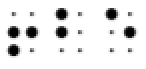 | be is not contracted after to which is contracted*. |
Initial-Medial-Terminal groupsings
In also used as wordsign, but not en.
in  not iness, ing not iness, ing | en  not ence, ment, enough*, silencer not ence, ment, enough*, silencer |
- They are used wherever the letters they represent occur. Instead of for en not be used when the letters form a word or an element of a hyphenated compound word. See Booklet « Braille: end of letters ».
♫♫♫
Composite wordsigns
- These wordsigns may be used as parts of words, subject to the rules which apply to them. There’s a lot of rules, and a lot of composite wordsigns.
- I chosen only these based on the sense or pronunciation.
When they retain their meanings as whole words
upon  | not coupon  |
those  | not thoseby  |
these  | not hypotheses  |
whose  | example whosesoever  |
When the a is short
had  | not haddock  |
When the stress is on the first e and the letter group not preceded by an e or i
ever  | not severe  |
When the letters it represents are pronounced as one syllabe
here  | not heresy  |
name  | not enamel  |
one  | money  except ending « oney » except ending « oney » |
When the letters it represents are pronounced as the word
some  | time  | sometimes  |
there  | not ethereal  | |
where  | not wherever  | but whereupon 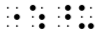 |
Simple upper wordsigns
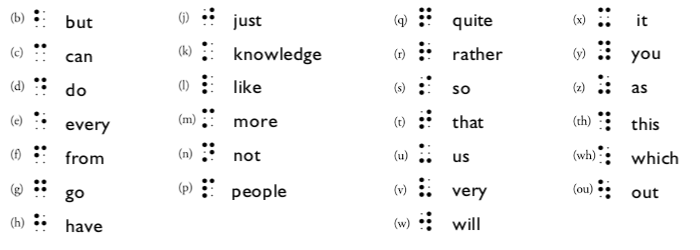
- Just like a word*.
- May be preceded or followed by punctuation signs, and may be preceded by the italic or capital signs and by the contractions to, into and by.
- Do not use between 2 quote signs*.
- Should generally be used before the apostrophe followed by d, ll, re, s, t, ve.
- May be used when joined by the hyphen in compound words.
- Should not be used for foreign words, or in other cases such as the musical note do “C” for example.
- They represent a letter or a simple upper groupsigns which, on their own, between 2 spaces, constitute the meaning of a word.
♫♫♫
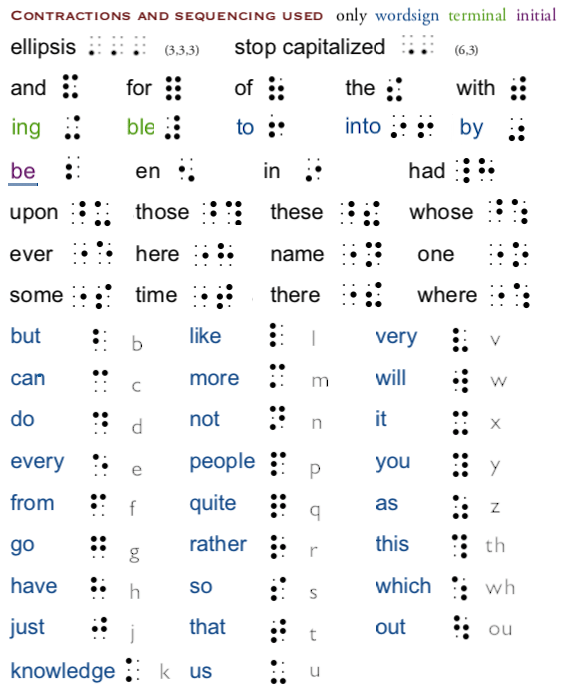
In blue, there’s the contractions I use only as a wordsign
♫♫♫
Books with a contracted transcription
Quentin Blake’s ABC
Quentin Blake © Quentin Blake 1989, one-to-one and contracted transcription in braille by Obel’Isa in 2025.
- Article of the theme: Braille touch.
 Ki-Regeneration ®