
Version française
Braille is a tactile writing system, using 6 raised dots, which allows you to write all languages, mathematics, music and to do layout.
♫♫♫
For a braille letter the 6 dots are always arranged in the same way  but they can represent a character or 2 lettres (
 , …,
, …,  ,… ) or a contraction (
 ,…) or a punctuation mark (
 ,…) or be considered as an indicator (
 , …
, …  , …).
, …).
In French, there is integral braille which consists of transcribing a text letter by letter and abbreviated braille which represents certain groups of letters and certain words with fewer braille letters. Abbreviated braille makes it possible to have a more concise text, faster to write and books that take up less space. English braille works this way, but the letter from a to z are the same.
While it is quite easy for a sighted person to learn braille and read it with the eyes, it is more difficult to read it with the fingers. This is why I decided to translate small books to practice.
I learned integral French braille which is close to Grade 1 in English: one-to-one transcription. I transcribe the English books letter by letter which means that my transcriptions are not the best, but since the aim is to develop the sense of touch, to help the brain to cure the body, this method is good in this context.
I introduced some contractions as I went along because I found that they provide an interesting variation to see the interaction with the brain.
You will find on this page all the books that I have transcribed. I can send you a copy for free, as sending mail in braille is free even for foreign country.
If you have small books (very small) that you would like me to transcribe into braille, send your request, I will be happy to do the one-to-one transcription if it is within my possibilities.
♫♫♫
Some tips for learning and reading braille more easily.
Do not learn letters visually. The 6 dots have a predefined number 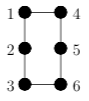 . You have to memorize the dots of the letters.
| Examples: | a  this is dot 1, memorize a (1) this is dot 1, memorize a (1) |
b  these are the dots 1 & 2, memorize b (1-2) these are the dots 1 & 2, memorize b (1-2) |
For the letters, the top 4 dots (1-2-4-5) form 10 possibilities and the bottom 2 dots (3-6) determine a decade, i.e. 3 decades for the 26 letters and 5 wordsigns: and, for, of, the, with which can be words or contractions, see booklet braille: wordsigns + by to.
There are 2 ways to understand their codes:
- By decade, which is better at the beginning to familiarize yourself with the 6 dots. Learn the position of the dots for each letter, decade by decade.
- By column, once the 3 decades have been studied. For each column the top 4 dots are identical, for each decade dots 3-6 are identical. Learning that a, k, u are from the same column, they will all have dot 1 and dots 3-6 of their decades, i.e. a (1), k (1-3), u (1- 4-6).
For the numbers, the numeric indicator (3-4-5-6) and the numbers (first decade). The indicator is only put at the beginning, it is active until a space, the caps (6) or letter (5-6) indicator. Dot 3 as thousands separator, dot 2 as decimal separator.
| Examples: | 10  (3-4-5-6, 1, 2-4-5) (3-4-5-6, 1, 2-4-5) |
| For the thousands 4,500  (3-4-5-6, 1-4-5, 3, 2-4-5, 2-4-5, 2-4-5) (3-4-5-6, 1-4-5, 3, 2-4-5, 2-4-5, 2-4-5) | |
| For decimals 0.7  (3-4-5-6, 2-4-5, 2, 1-2-4-5) (3-4-5-6, 2-4-5, 2, 1-2-4-5) | |
| The time 10h25  (3-4-5-6, 1, 2-4-5, 5-6, 1-2-5, 3-4-5-6, 1-2, 1-5) (3-4-5-6, 1, 2-4-5, 5-6, 1-2-5, 3-4-5-6, 1-2, 1-5) | |
| The time 5.30 pm  (3-4-5-6, 1-5, 2, 1-4, 2-4-5, ,4-5, 1-2-3-4, 1-3-4) (3-4-5-6, 1-5, 2, 1-4, 2-4-5, ,4-5, 1-2-3-4, 1-3-4) | |
| An oblique stroke to denote « per » 100/sec  (3-4-5-6, 1, 2-4-5, 2-4-5, 4-5-6, 2-3, 2-3-4, 2-5, 1-4) (3-4-5-6, 1, 2-4-5, 2-4-5, 4-5-6, 2-3, 2-3-4, 2-5, 1-4) | |
| An oblique stroke to separate groups of letters and/or numbers ab/1234  ( 1, 1-2, 4-5-6, 2-3, 3-4-5-6, 1, 1-2, 1-4, 1-4-5) ( 1, 1-2, 4-5-6, 2-3, 3-4-5-6, 1, 1-2, 1-4, 1-4-5) | |
| Avoid the oblique stroke for dates 8/9/36  (3-4-5-6, 1-2-5, 3-4-5-6, 2-4, 3-4-5-6, 1-4, 1-2-4) (3-4-5-6, 1-2-5, 3-4-5-6, 2-4, 3-4-5-6, 1-4, 1-2-4) | |
1981-1990  (3-4-5-6, 1, 2-4, 1-2-5, 1, 3-6, 3-4-5-6, 1, 2-4, 2-4, 2-4-5) (3-4-5-6, 1, 2-4, 1-2-5, 1, 3-6, 3-4-5-6, 1, 2-4, 2-4, 2-4-5) | |
22a  (3-4-5-6, 1-2, 1-2, 5-6, 1, 2-5-6) (3-4-5-6, 1-2, 1-2, 5-6, 1, 2-5-6) | |
8.IX.36  (3-4-5-6, 1-2-5, 6, 2-4, 1-3-4-6, 3-4-5-6, 1-4, 1-2-4) (3-4-5-6, 1-2-5, 6, 2-4, 1-3-4-6, 3-4-5-6, 1-4, 1-2-4) |
For punctuation -5th decade, this is the first decade taken down a notch. Not all characters are punctuation, there are also en and in, which are Initial-Medial-Terminal Groupsigns ; in is also used as wordsign, see booklet braille: end of letters. No space between a word and the punctuation mark but a space between the sign and the following word.
| Example: | …  ellipsis (3, 3, 3) ellipsis (3, 3, 3) |
For the rest, you need to learn. I don’t use contractions, except by, to.
Space is represented by the 6 empty dots. It is very important for reading. And, for, of, the with, to, by, in, into contractions should be written unspaced from a word which follows, even when a sense break or natural pause is present.
Don’t read with your eyes closed to imitate a blind person. This adds stress to the brain which will have difficulty memorizing the code, will get tired and lose concentration.
You must open your eyes and look in front of you without paying attention to what you see but “pay attention to the sight under your fingers”. This is the picture. You have to really concentrate on the feeling of your fingers in order to feel each dot and the spaces.
For alphabet books, there is only one word, you read it from left to right with the pulp of the index finger of the hand you want. There is always one hand better than the other, but both work. Reading braille is ambidextrous. The letters of the alphabet book are also in relief so you can feel them.
For stories, the text is a whole line, the two hands read the line: the left reads to the left and the right to the right, we change hands halfway through. At the beginning we place the left index finger on the first braille letter on the left, the right little finger on the last letter and the right index finger on the middle letter. The left travels the beginning until meeting the right index which continues and the left index goes down one line, it positions itself at the start of the next and when the right has finished, it joins the left in the middle of the next line and the left begins reading until they meet. And so on.
♫♫♫
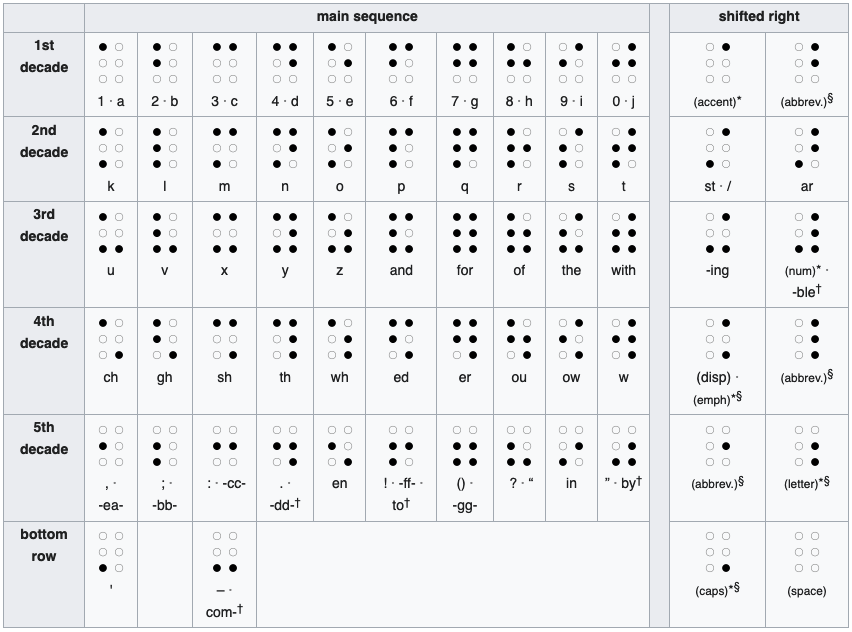
English braille letter chart.
I don’t know exactly how to use contraction characters, so I do a one-to-one transcription.

Remarks :
- 5th decade corresponds to 1st decades moved down one notch. Only dots 2-3-5-6 are used.
- Bottom row corresponds to 5th decade moved down one notch. Only dots 3-6 are used, which is why there are only 2 possible characters.
- The left column of the shifted right only uses dot 4 of the top 4 dots (1-2-4-5) and the 3 possibilities for dots (3-6) which gives 4 possibilities. Then dot 4 moved down one notch for a 5th possibility then moved down another notch for the 6th possibility.
- The right column of the shifted right uses the 2 dots 4-5 among the top 4 dots (1-2-4-5) and the 3 possibilities for the dots (3-6), which gives 4 possibilities. Then the dots 4-5 moved down one notch for the last possibility with dots. Finally, the space which does no dots.
♫♫♫
Click on a book to browse it in digital format.
If you would like a paper version of the booklets by decade so that you can practice reading with your fingers, send me a request with your postal address to obel.bourgait@gmail.com. Sending letters in Braille is free, even to foreign countries. I do not have stock, I transcribe the books as requests arise, but I do my best to send them quickly.
Alphabet books, picture books
In shape
Ingrid Chabbert and Marjorie Béal ©2013 Langue au Chat, one-to-one transcription in braille by Obel’Isa in 2025.
Quentin Blake’s ABC
Quentin Blake © Quentin Blake 1989, one-to-one and contracted transcription in braille by Obel’Isa in 2025.
ABC’s
Charley Harper ©2008 AMMO Books, one-to-one transcription in braille by Obel’Isa in 2024.
♫♫♫
Children’s books
my heart
Corinna Luyken ©2019 Corinna Luyken, transcription in braille by Obel’Isa in 2025.
Why does the wind blow?
World of Eric Carle © 2025 by Penguin RandomHouse LLC, contracted transcription in braille by Obel’Isa in 2025.
♫♫♫
The booklets by decade of Braille
First decade of braille
Isabelle Bourgait copyleft 2024 Universe Art, Realisation and transcription in braille by Obel’Isa.
Second decade of braille
Isabelle Bourgait copyleft 2024 Universe Art, Realisation and transcription in braille by Obel’Isa.
End of letters and puntuation in braille
Isabelle Bourgait copyleft 2024 Universe Art, Realisation and transcription in braille by Obel’Isa.
Wordsigns in braille
Isabelle Bourgait copyleft 2024 Universe Art, Realisation and transcription in braille by Obel’Isa.
Braille contractions and sequencing that I use
Here are the contractions I introduced to provide an interesting variation of brain interaction.
- Article of the portfolio: The senses.
- Article of the theme: Activate brain plasticity using Braille.
- Discover: Musical braille touch.
 Ki-Regeneration ®